Somewhere in a dating app right now, a little timer is counting down, waiting for you to send a first message within 72 hours or it will quietly close the match on your behalf. You are at a school concert. You will get to it next Thursday, possibly. So here is the thing nobody who builds these apps seems to have clocked: the problem was never that you stopped wanting to meet someone. It is that you have maybe three genuinely free evenings this month, two of which are Tuesdays, and every mainstream app was designed for a person with five free nights a week and a thumb permanently on the glass. That is the mismatch. It is not a flaw in you. It is a flaw in a product built for a life you do not have.
If your free time is scarce and hard to predict and you want a serious long-term relationship, the thing in your way is not your desire, your face or your history. It is that these products reward being constantly present, and being constantly present is the one thing your week will not let you be. A service built around a small number of introductions, instead of a feed that needs feeding every night, fits that life better. It will not make anyone fall for anyone, and nobody who charges you money can honestly promise otherwise.
The constraint is hours, not interest
Start with what is actually scarce, because it is not affection and it is not effort. It is an evening that is child-free, predictable, long enough to matter, and lined up with another adult who is also free. Those four rarely turn up together, and when they do it is two weeks out, assembled through four text messages and a called-in favour, with the quiet logistical pride of someone who has just moved a piano up a staircase.
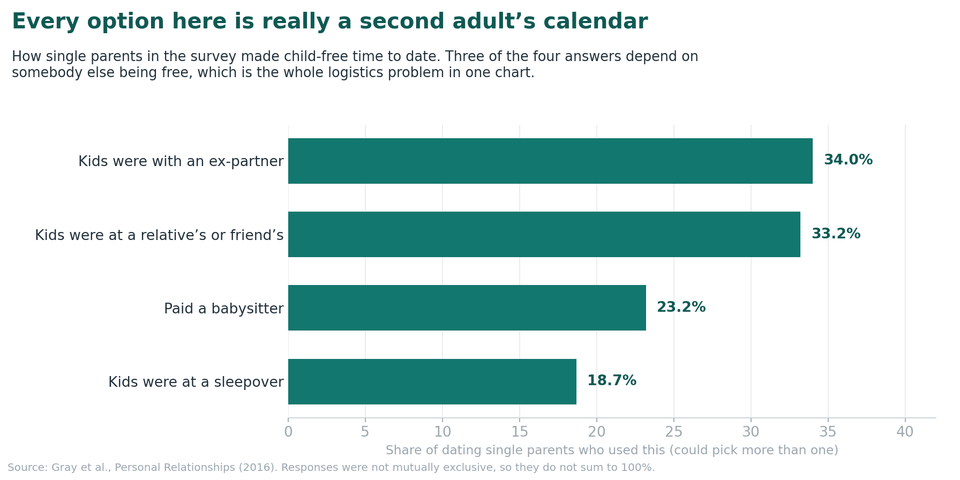
The one large study that asked single parents how they actually made the time is revealing less for its numbers than for their shape. The commonest routes were a child spending the evening with an ex-partner, or at a relative's or a friend's, each used by about a third of the parents who dated; a paid babysitter and a child's sleepover came behind. Every line on that list is really a second adult's calendar. Your availability is not really yours. It is a sublet.
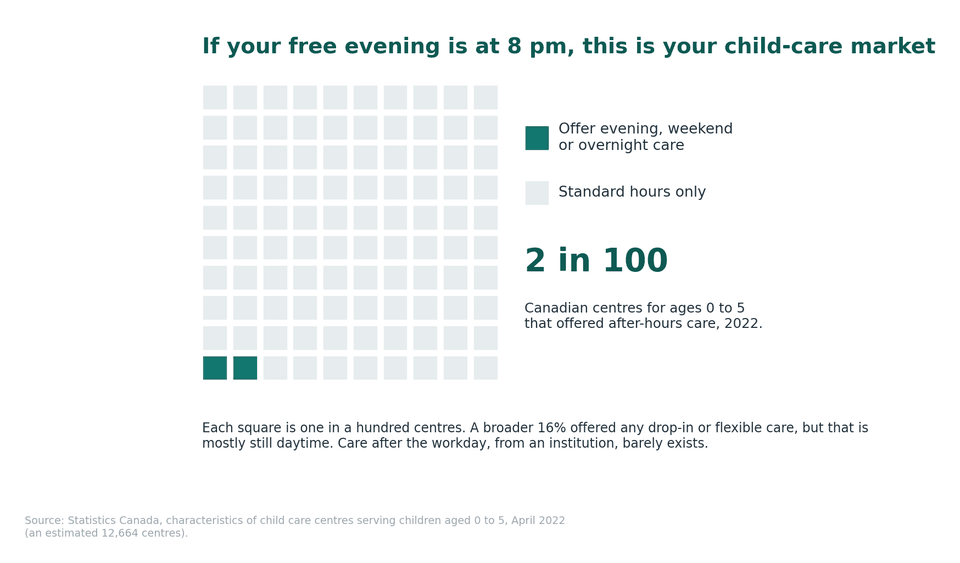
And if the plan was to solve this by buying an evening at short notice, the market has news. Among Canadian child-care centres for children aged newborn to five, two in a hundred offered evening, weekend or overnight care in 2022, according to Statistics Canada (opens in a new tab). Two. That is not a typo, and it's not a personal failing. A wider 16 in a hundred offered anything drop-in or flexible at all, and most of that is still firmly daytime. Regulated child care in this country keeps banker's hours and clocks off at roughly the moment a first date would begin.
None of this means you have no time at all. It means the time you do have is expensive to turn into an actual evening out, and a wasted one costs you far more than it costs someone with five free nights a week and no one to answer to. That is the real asymmetry, and no amount of make-yourself-a-priority advice lays a finger on it.
The number everyone quotes about parents is misread
Here is where the received wisdom goes wrong, and it is worth having straight, because you will hear it again at a dinner party. In one US study of single parents (opens in a new tab), 62.2 percent came out as not actively seeking
a relationship. It is a tempting figure. You can hang a whole mournful headline on it: parents, too busy to love. It cannot hold the weight.
That one box quietly contained three completely different people: someone open to the right person but not out looking, someone who genuinely has no time, and someone who is enjoying being single and would like everyone to stop asking. The study never measured how big each group is. It put them in a box, taped it shut, and reported the box.
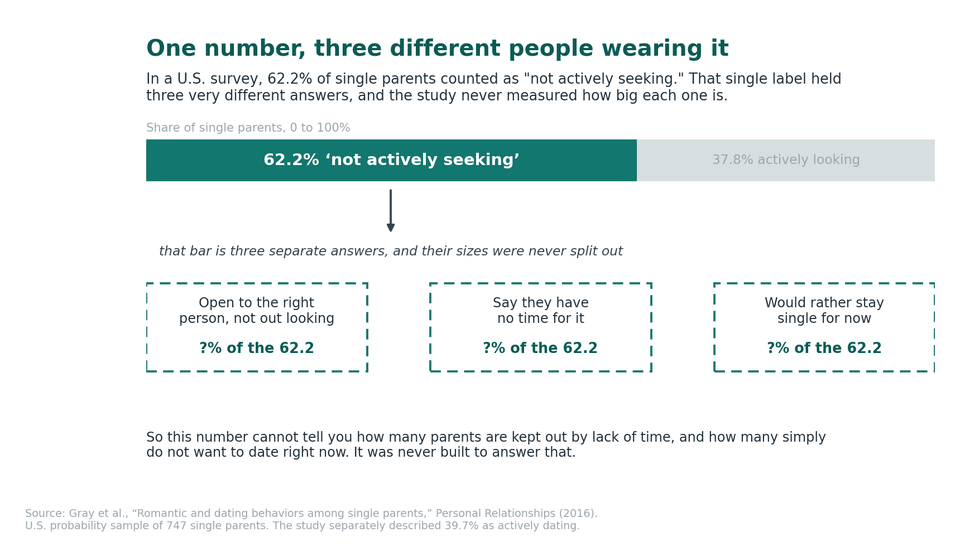
So the honest version is narrower and a lot more useful. Time is a real barrier for many parents. It has never been shown to be the main barrier for most of them, because the surveys that could show it never opened the box. Anyone who tells you every parent is a thwarted romantic held back only by their calendar is selling a certainty the data does not contain, usually with something attached. And some parents are simply enjoying a stretch of their own life, which is a complete answer that needs no fixing and no app.
Why the usual advice fails you in particular
Most dating advice assumes the cure is volume. See more people, swipe wider, meet everyone, and the numbers will eventually tilt your way. The category's own word for this is putting in the reps
, as though romance were a gym membership, which, financially, is roughly how it has been sold to you. Volume is precisely the ingredient you cannot add. Every extra profile is one more small tax on attention you have already spent, several times over, on things that do not reschedule.
It gets worse, because the apps are not neutral bystanders. They are participation systems, and they reward being around, which is written plainly on the mainstream apps' own help pages rather than hidden. Tinder says it prioritises people who are active, and active at the same time as others. Hinge, through a setting it calls Your Turn Limits, stops handing you new likes when too many conversations are waiting on your reply, until you catch up. Bumble expires a match if no first message is sent inside 72 hours. It is the same logic that has an app cheerfully offer to sell you a boost at 9:14 pm, in the one ten-minute window you had, which you are now spending here.
Read that carefully, because the careful version is the persuasive one. None of it proves any app singles out parents, and no study has shown that they do; we are not going to pretend one has. What is true is quieter and harder to argue with: a system that rewards constant presence is a poor fit for a life where presence turns up in bursts. A slow reply is read as low interest when it usually means a bath, homework and a lunch to pack. That little timer from the first paragraph is the whole model, really, just given a brand name and a 72-hour fuse. The app is not malicious. It is patient the way a parking meter is patient, and about as interested in your reasons.
If part of you suspects the problem is you
Maybe some part of you has quietly concluded that having kids has made you a harder sell, and that the thin results are the proof. The results are real. The conclusion is wrong, and it is wrong for a structural reason, not because you need cheering up.
Nothing about having a child makes you worse company across a table. What changed is the fit between your week and the interface, and that is a fact about the interface. A product that needs nightly attention will underperform for anyone who cannot pay nightly attention, no matter how good they are, how they photograph, or how the evening would actually go. You are not getting a thinner result because you are worth less of someone's time. You are getting a thinner result because an app decided to grade you on attendance, and you are, correctly, elsewhere.
Honesty also means not flattering you. Your situation varies in ways a web page cannot know: shared custody on a tidy alternating week, or sole care with no second adult for miles; money to buy an evening, or none to spare; a co-parent who helps, or the co-parent who is the reason you are reading this. We are not going to guess which, call you brave or juggling, or suggest that a new partner would be marvellous for the children. The only claim here is about arithmetic and design, and it survives all of those situations without needing to know yours.
What a service built for your constraint would need
Forget any particular company for a second. If you sat down to specify the thing from scratch, four requirements fall straight out of everything above, and you can hold any product up against them, this one included. First, fewer and better-qualified introductions, so the rare evening goes to someone who already clears your hard limits rather than to a stranger a dozen screens down. Second, the ability to rule things out in advance, in writing, before anyone drives across town to discover them in person. Third, something that does not punish absence, so a fortnight of silence for entirely good reasons does not cost you the match or your place in the queue. Fourth, real conversation before the evening is spent, so meeting in person is a decision you have half made already, rather than a coin toss with a haircut.
A smaller number of introductions is not a smaller version of the same product. It is a different product. One spends your attention on a feed. The other spends it on a few people you could plausibly meet before one of you moves house. None of those four requirements is a promise about the outcome, either. A good relationship beats an empty evening, and a bad one is a great deal worse than either, so the goal was never more dates. It is fewer, better-aimed ones.
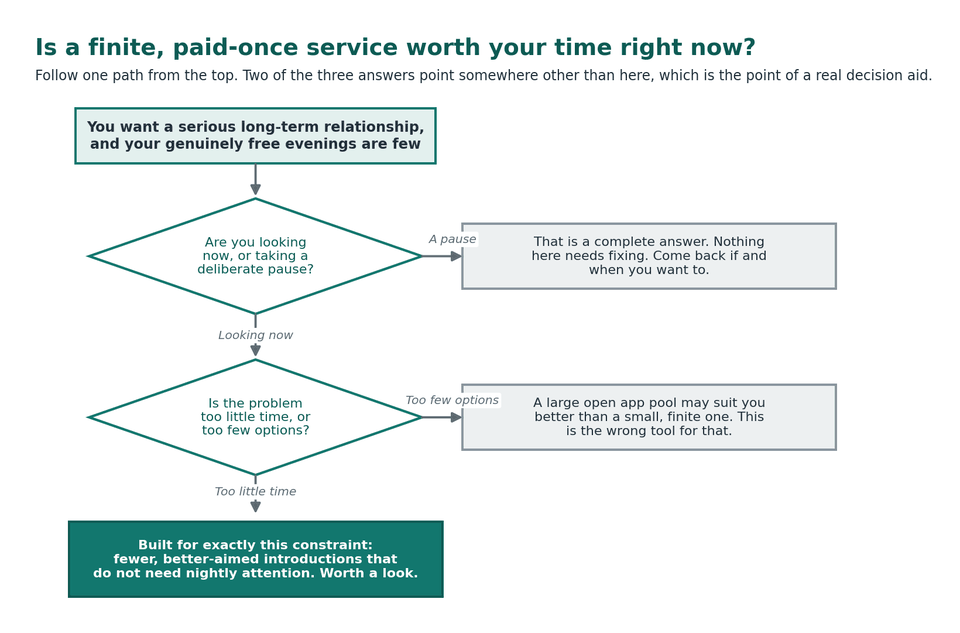
Before you take any of this as a nudge to sign up, here is the honest version of the choice, and two-thirds of it points away from us. If you are taking a deliberate pause from dating, nothing here needs fixing, and you should come back when you want to. If you are looking but what you actually want is more options rather than more time, a large open pool will serve you better than a small finite one. It is only if the thing biting you is time, and the cost of a wasted evening, that a finite, paid-once service is built for your constraint at all.
Key takeaways
If you are a parent with few free evenings, the problem is almost never that you have stopped wanting a relationship, it is that mainstream dating apps are built to reward constant presence and you cannot supply it. The often-quoted figure that most single parents are not actively seeking
collapses three different groups and cannot tell you how many are held back by time rather than choosing a pause. Regulated after-hours child care barely exists, at two in a hundred centres, so a free evening is expensive to arrange and a wasted one costs you more than it costs anyone with five free nights a week. The honest fix is not more volume, which is the one thing you cannot add, but fewer and better-aimed introductions, the ability to rule things out in advance, and a service that does not penalise you for going quiet. Kindred is built that way and charges once rather than by the month, which changes the incentive without pretending anyone can predict who you will click with.
How Kindred is built, and what that still does not do
Kindred Matchmaking is a not-for-profit, which is not a personality it has adopted. It is a structure, and the structure is the whole point: nobody makes more money when you stay single, because there is no monthly fee in the background quietly hoping the months keep coming. Membership is paid once rather than by the month, which removes the incentive every subscription app carries to keep you busy rather than to see you off happily, ideally with someone. That gradient is real and quiet, and it is why an app funded by the month is not built to help you leave.
The mechanics follow those four requirements, and each arrives with its limit attached. Kindred is built around a finite number of introductions rather than a feed you scroll, so there is less to manage and nothing that benches you for falling behind on replies. It applies your hard dealbreakers as rules before anyone is ranked, so you are never asked to scroll politely past an obvious no. An introduction opens with shared questions and an actual conversation, and photos appear only after both people separately choose to release them, so the first thing you exchange is a sentence rather than an unsolicited photo at 11 pm. Everyone you can be matched with has verified their identity. All of which means Kindred makes you talk to someone before it will show you their face, which is either the entire point or an acquired taste, depending on the kind of week you have had.
Now the limits, in the same breath. Aligned economics do not make the matching cleverer; they only stop it getting worse on purpose. Ruling out your dealbreakers is not the same as knowing who you will like, and Kindred shows no compatibility percentage and makes no claim to predict chemistry, because no one can do that from a questionnaire, and the people who say they can are selling the certainty, not the result. Verification raises the cost of running a fake profile. It does not make a first date safe, and nothing does.
This is the same Kindred as everyone else's. There is no separate parents' product, no separate pool, no separate price, and no roped-off parents' section with its own sad lighting. A page written for your situation is just a more honest front door to one shared pool. What makes a small local service worth joining is that the people in it are near you and want the same kind of thing, and that only works as one pool, not a dozen thin ones wearing different labels.
The honest next step
If a service built on a small number of introductions, your dealbreakers applied up front, and a real conversation before any photo sounds like it fits your life, then it is worth a try. It will not hand you a person, and it cannot promise chemistry, because nobody can. What it can do is put your scarce evenings in front of people you might actually meet, instead of in front of a feed that was going to keep scrolling with or without you.
Questions people actually ask
Is dating even realistic when I only get a couple of free evenings a month? Yes, though not through a product that assumes you have five times as many. The realistic route is fewer, better-aimed meetings, where the rare free night goes to someone who already clears the things you will not budge on. The problem was never your interest. It was a tool built for a schedule you do not have.
Do dating apps actually push single parents down in the results? There is no evidence they identify parents and bury them, and anyone who says otherwise is guessing. What is documented, on the apps' own help pages, is that several reward constant activity and fast replies. That is not aimed at you. It just fits badly with a week whose free time arrives all at once and then not again for a while.
Does Kindred have a separate service or pool for parents? No. One service, one pool, one set of terms, one price for everyone. This page is written for your situation, but the thing behind it is shared. A separate parents' pool would be a smaller and worse pool, which is the opposite of the point.
Will a smaller number of introductions actually get me a better relationship? Nobody can promise that, and Kindred does not. Fewer introductions mean your limited attention goes to people you could realistically meet rather than to an endless feed, which is a better use of it. It is not a guarantee, and any service that guarantees one is selling a certainty it does not own.
Do I have to say anything about my children, custody or co-parenting to sign up? No. You decide what to share and when, and the service does not assume any particular custody or family arrangement on your behalf. What you disclose, and to whom, stays your call.
How much does it cost? Kindred runs on a one-time membership rather than a subscription, so there is no monthly bill working against you. The exact price sits on the join page rather than in this article, because a number is the kind of thing that changes and this page is built to stay true.