If you live in Mississauga and match with someone in Scarborough, congratulations on your long-distance relationship. You haven't met yet, and you're already negotiating Union Station. Dating in Toronto is hard because the apps run on volume, on the theory that enough first dates will eventually produce a good one, and Toronto charges more per first date than almost anywhere in Canada. The apps would be tiring anywhere. Here, they're expensive.
The apps work by volume: meet enough people and one will stick. Toronto makes every attempt cost more, in travel, in having nowhere private to go, and in the friends of friends most people meet partners through. So what feels like your failure is mostly arithmetic, and the answer is fewer, better-filtered first dates, not more of them.

Photo: Gratisography (opens in a new tab) · Gratisography licence (opens in a new tab)
The trip is the first date before the first date
You know the moment. The chat has been lovely for three days, someone types "we should grab a drink", and you both go quiet and open a map. The app said six kilometres. The app has never waited for the 29 Dufferin.
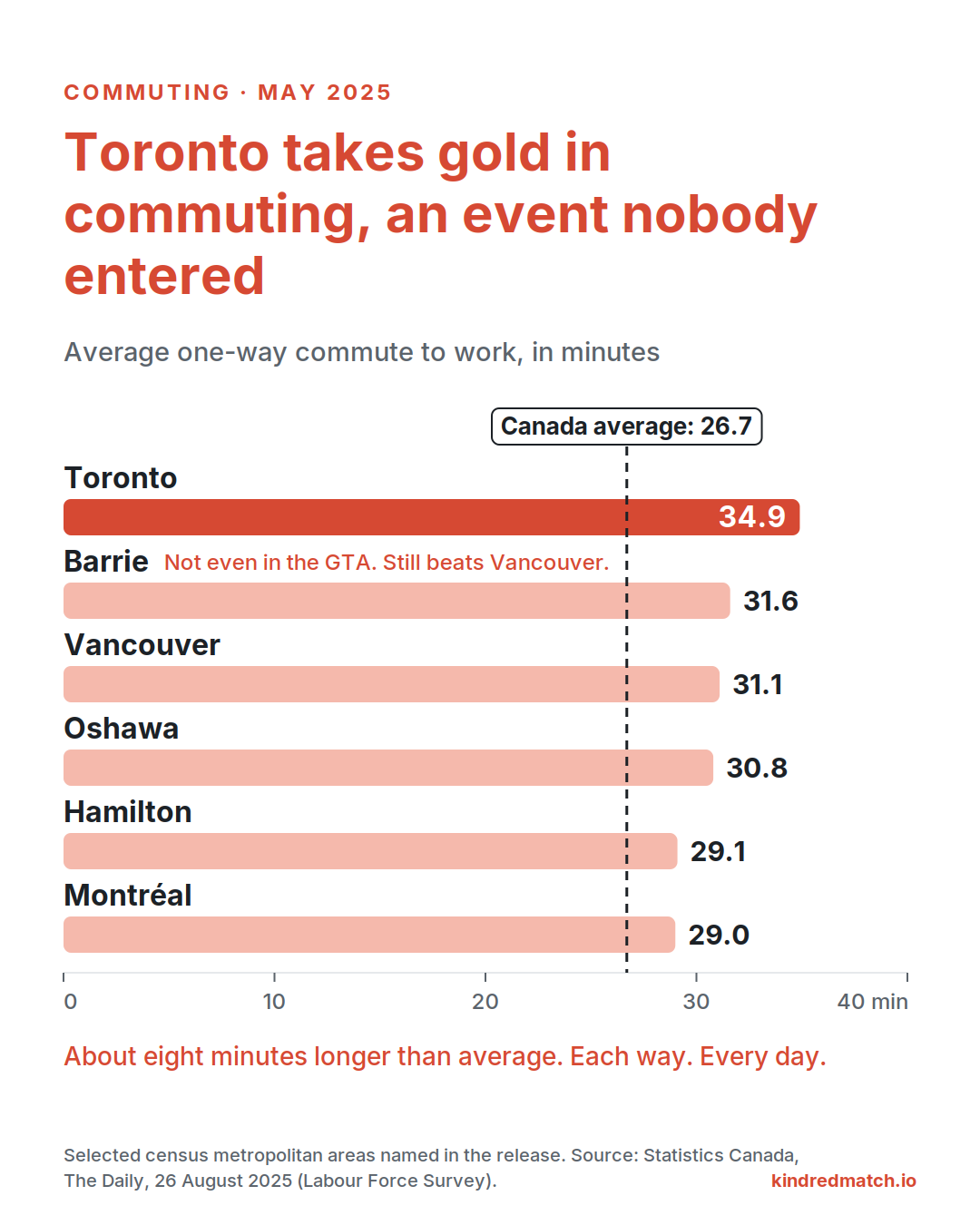
Toronto has the longest average commute in Canada (opens in a new tab), and that's for trips people are paid to make. A first date is the same trip, unpaid, on a Tuesday. So the negotiation ends where GTA negotiations always end: somewhere near Union, a place nobody wants and everybody can reach, which is the region's working definition of fair.
You'll know it's going well when you stop checking the last train. You'll know it's going very well when you start pricing a ride back to Mississauga.
Home is a harder word here
"Come over for dinner" is a lovely offer. In a lot of the GTA, it's also a guest list. Nearly half of Toronto-area adults aged 20 to 34 (opens in a new tab) live with at least one parent, against about a third nationally (opens in a new tab). For some that's a family arrangement they'd choose again. For some it's the rent. For plenty it's both, and nobody's keeping score.
So new relationships here spend months in restaurants, which is romantic for about three weeks and then starts arriving on your credit card statement like a second lease. The relationship is fine. It has nowhere to sit down.
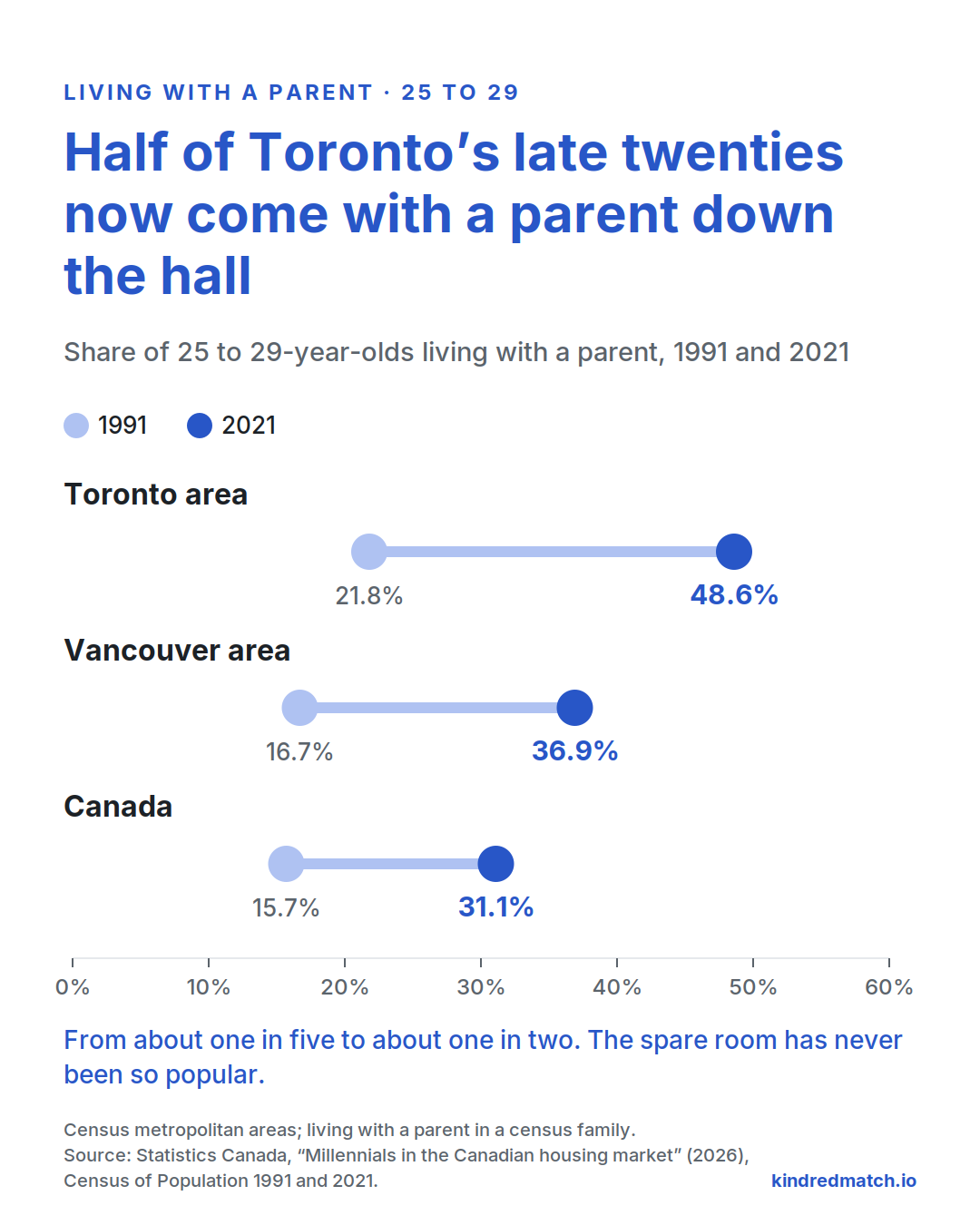
For people in their late twenties the share more than doubled in a generation, according to a 2026 Statistics Canada study of housing across generations (opens in a new tab). Worth remembering the next time a think piece calls it a character flaw.
Most people meet partners through people
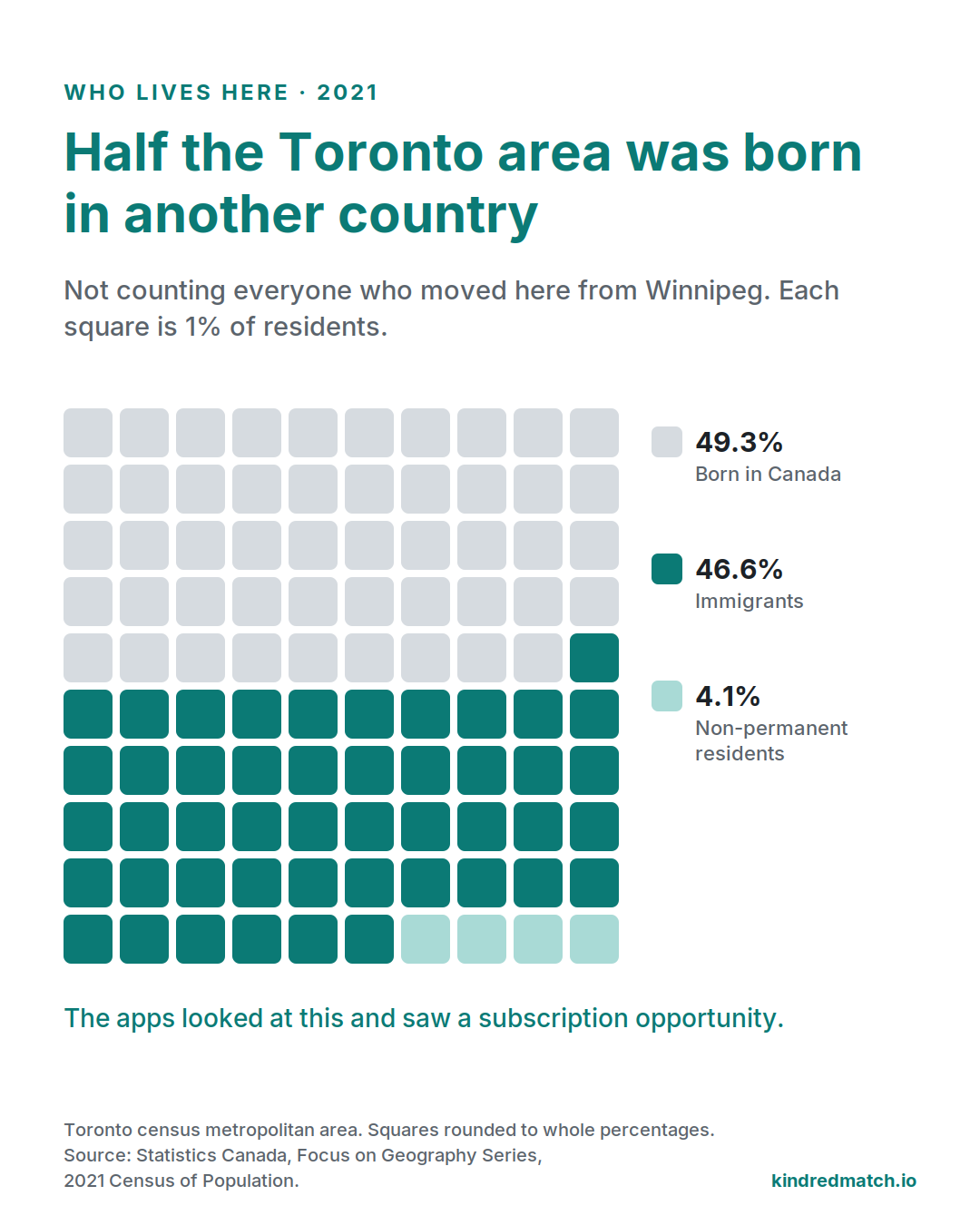
If you grew up here, you're dating through fifteen years of people who know people: a cousin's coworker, a friend's old roommate, someone from a birthday in Etobicoke. If you moved here, you have a lease, a Presto card and a colleague who is almost a friend, and has been almost a friend since March.
That gap matters. In research on how relationships begin (opens in a new tab), about two thirds of people said theirs started as a friendship (the samples were students and adults recruited online, so read it as a strong pattern, not a rule). Circles take years, and the Toronto area is built on arrival. The apps noticed, and offered to rent you a circle by the month.
Why volume is a bad deal here
The feed has one promise: there's always someone else. That promise has a measurable cost. In experiments on online dating (opens in a new tab), the chance of saying yes fell by about a quarter from the first option to the last, as people grew less impressed by the pictures and gloomier about their own chances. Meanwhile a subscription app earns more for every month you keep looking, so it has no reason to make any one match feel precious.
In a small city, that's a mild annoyance. In Toronto, it's an all-you-can-eat buffet where every plate costs two transfers and dinner for two. Nobody designed it for Toronto. Toronto is where the bill runs highest.
People here aren't cold. They're budgeting.
You've heard that Torontonians are cold, and you may have privately wondered whether it's you. The duller explanation fits better. When every date costs an evening, people cancel the uncertain ones, postpone the ones across town and go conspicuously vague about Thursday. From outside, that looks like flakiness. From inside, it's someone staring at a trip planner.
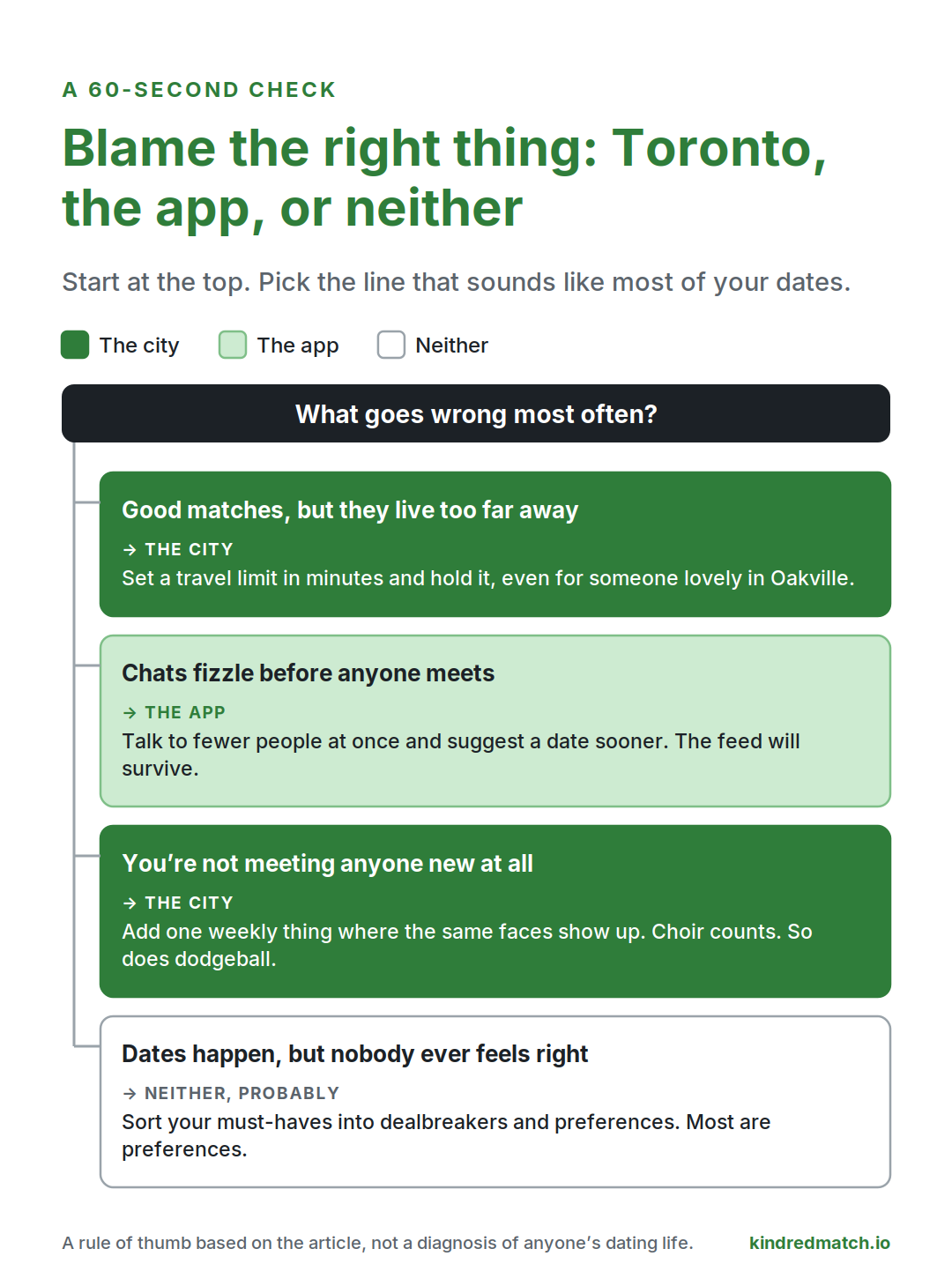
The same goes for you. Turning down a date that needs three transfers is ordinary budgeting, and budgeting is allowed. If you're not sure which part of the problem is yours, the chart below takes a minute.
Spend fewer evenings, and spend them better
If each attempt is expensive, make fewer attempts that are more likely to be worth the trip. Whatever you try next, ask it four things. Does it deal with distance before you're invested? Does it rule out the deal-enders (children, faith, the kind of relationship you want) before you're across a table? Does it give you a few people to take seriously, or an endless supply to skim? And does it earn more if you keep looking? Then keep one thing in your week where the same people show up every time. Nobody at choir is auditioning, which makes it the easiest place in the city to become a friend first. (If your must-have list has grown long, this piece on dealbreakers and preferences is worth ten minutes.)
How Kindred is built for a city that charges by the evening
Kindred is a not-for-profit, not a transit agency. We have stared at the map for a long time and the 401 has not moved. What we can do is spare you the evenings spent discovering something you could have known in advance. Before anyone is introduced, a short questionnaire takes the deal-enders off the table: children, the kind of relationship you want, faith and whether a partner must share it, whether you're looking toward marriage, whether you drink, and six more. Location is handled by matching within your city rather than by a radius slider. Introductions are finite, nobody can pay to be seen, and membership is one fee, once, so nobody here earns more when your search drags on. (Here's our honest comparison with the big apps, including where we lose.)
The limit is the one everyone has and few admit: we can't tell you who you'll click with, and neither can anyone selling a compatibility percentage. What we can do is make sure the trip to Union is for someone who has already cleared the things that would have ended it on the platform.
Key takeaways
Dating in Toronto is hard mostly because the apps run on volume and Toronto makes each attempt expensive: Canada's longest average commute, nearly half of young adults living with a parent, and a region where about half the people were born in another country and many are still building the circles most relationships start from. The better strategy here is fewer, better-filtered first dates, a travel limit set in minutes, and one weekly thing where the same people show up.
Questions people in Toronto actually ask
Is dating in Toronto harder than in other Canadian cities?
In a few measurable ways, yes. Toronto has the longest average commute in Canada, one of the highest shares of young adults living with a parent, and a population where about half were born in another country. We found no good data on whether people here find partners less often. The swiping is equally tiring everywhere.
Why do people in Toronto cancel dates so often?
Often because the date is expensive before it has started. When a first meeting means an hour each way and a restaurant bill, an uncertain match is easy to postpone. That reads as flakiness, and sometimes it is. It can equally be someone doing the math on a weeknight. Either way, it isn't a verdict on you.
How far is too far to date in the GTA?
Kilometres won't tell you, because six of them can be one subway ride or a very long evening. Work it out in minutes instead: the longest weeknight trip you'd happily make, both ways, to see someone a second time. Then set your app's distance to match, before you meet someone lovely who lives two transfers past it.
Is it harder to date if you still live with your parents?
It changes the logistics more than your chances. More of early dating happens in public, someone may meet your household sooner, and restaurants end up doing a lot of the work. Nearly half of Toronto-area adults aged 20 to 34 live with at least one parent, so you're describing a common arrangement, not confessing to one.
Does a smaller number of introductions mean meeting fewer people?
Yes, on purpose. The trade is fewer people you skim for more people you'd plausibly want to meet. It doesn't guarantee a better outcome, and nobody can promise chemistry in advance. What it changes is where your evenings go: a long trip is spent on someone who has already cleared your dealbreakers.
Where Kindred is right now
Kindred is open in the Greater Toronto Area now, and matching is running here. Joining means a short dealbreaker questionnaire and identity verification; during the founding pilot the first 1,000 members join free for life, and after that membership is a one-time fee listed in the FAQ, never a subscription. What you get is introductions to people who have cleared the same filter, not a promise of a relationship.