Open a dating app and it asks who you want to date. Men, women, or everyone. You pick everyone, because that's the closest to the truth. The app treats that as permission to show you the whole city, in no real order. A screen later it asks your height, and it wants a number. Your love life gets three buttons. Your height gets a slider.
You've probably heard that being bisexual doubles your options. It doesn't, and that isn't your fault. Two things get in the way. The first is other people: plenty of them won't date someone bisexual at all, and that's been measured, not guessed. The second is the app: it took that one word from you and used it to decide who you meant. So your pool looks bigger on paper, and your actual weekend looks the same as before.
Your options aren't set by how many genders you're attracted to. They're set by two things: how many people are willing to date you, and what the app does with the one word you gave it. Neither of those is about you.
Why the bigger pool gets smaller on the way to you
Start with the part no app can fix, which is other people. Researchers asked straight, gay, lesbian and bisexual people how open they were to dating each other (opens in a new tab). Straight, gay and lesbian people were all less willing to date a bisexual person than bisexual people were to date them. The bias was strongest against bisexual men, and even bisexual women showed it. The researchers named it plainly: bias about bisexuality, not people preferring their own.
Two things that study can't tell you. It can't tell you what people actually do, only what they clicked in a survey. And it can't tell you why the person you liked went quiet on Thursday, because nobody sends a receipt. What it does tell you is where the problem sits. You can rewrite your profile tonight. You can't rewrite who's willing to read it.
The research also runs out fast. Almost all of it is about bisexual people specifically. If you're pansexual or omnisexual, you're being handed a finding nobody actually tested on you. Academia does this a lot. It studies the group it can recruit, and files everyone else under the plus sign.
The largest group in the room is the one designed for last
One number first, because it makes everything after it worse.
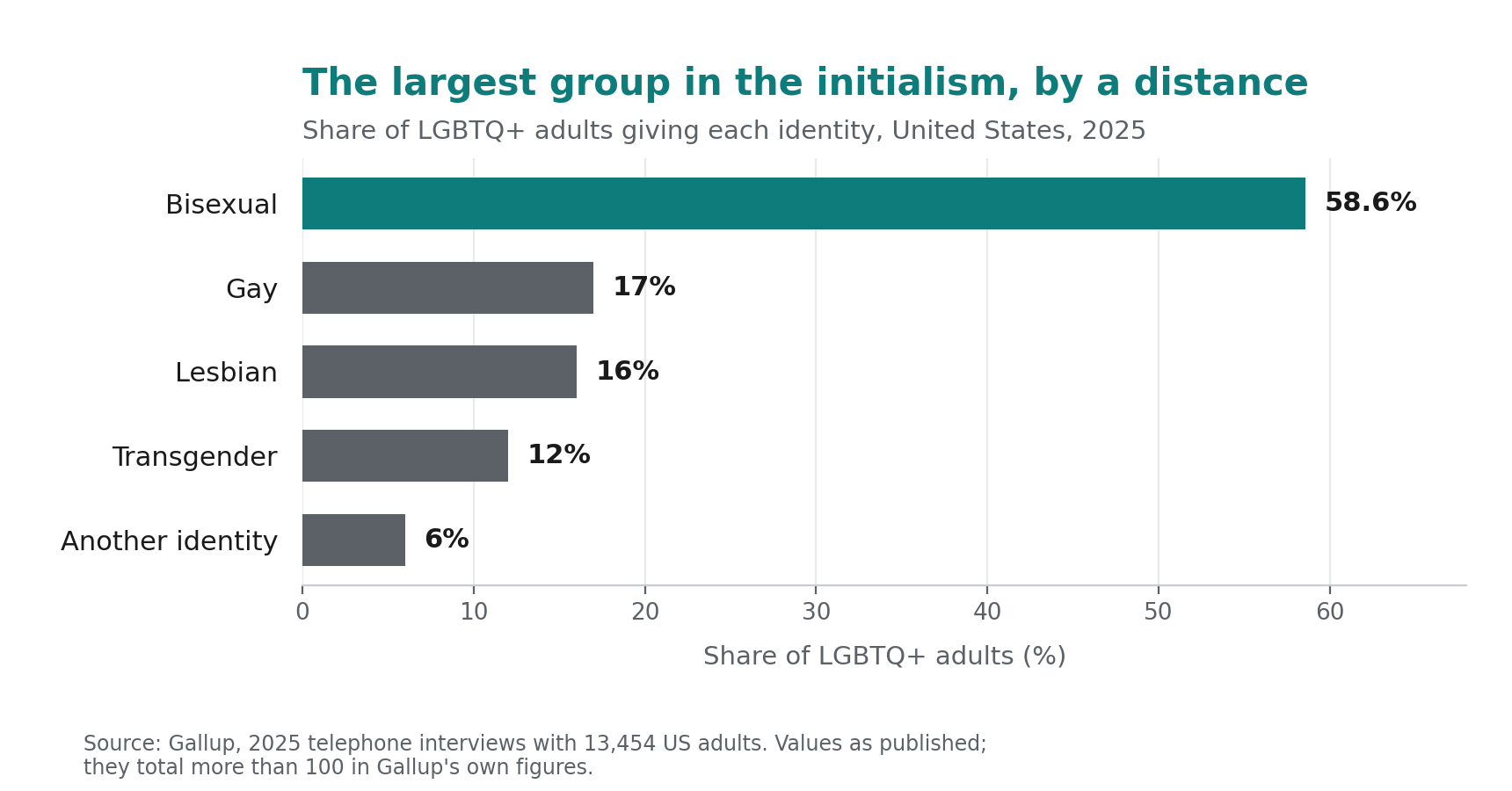
More than half of LGBTQ+ adults are bisexual, according to Gallup's latest US survey (opens in a new tab). That's about one in twenty adults overall. Dating apps treat bisexual people like a rounding error, and it turns out the rounding error is most of the group.
The label arrives before you do
Here's the part an app could fix if it wanted to. Most apps ask your orientation in the first few minutes, then use that one answer to decide what you see for months. It's a cheap shortcut, and it's wrong in a simple way. "Bisexual" tells the app what you are. It says nothing about who you want to meet right now, in this city, at this age. The app can't tell the difference, so it fills in the blank for you and matches you to its own guess.
Then that one word becomes something other people can filter you out with. The same app that wants your height down to the centimetre gives your orientation a single box and never asks a follow-up. What it does with that box is a secret, and nobody outside the company can check it. Every June the logo turns rainbow. The box stays exactly where it was. There's more on what an app can and can't know before two people meet if you want it.
None of this is the whole story of your last two years. But it's worth knowing the same app is a different app depending on who is using it.
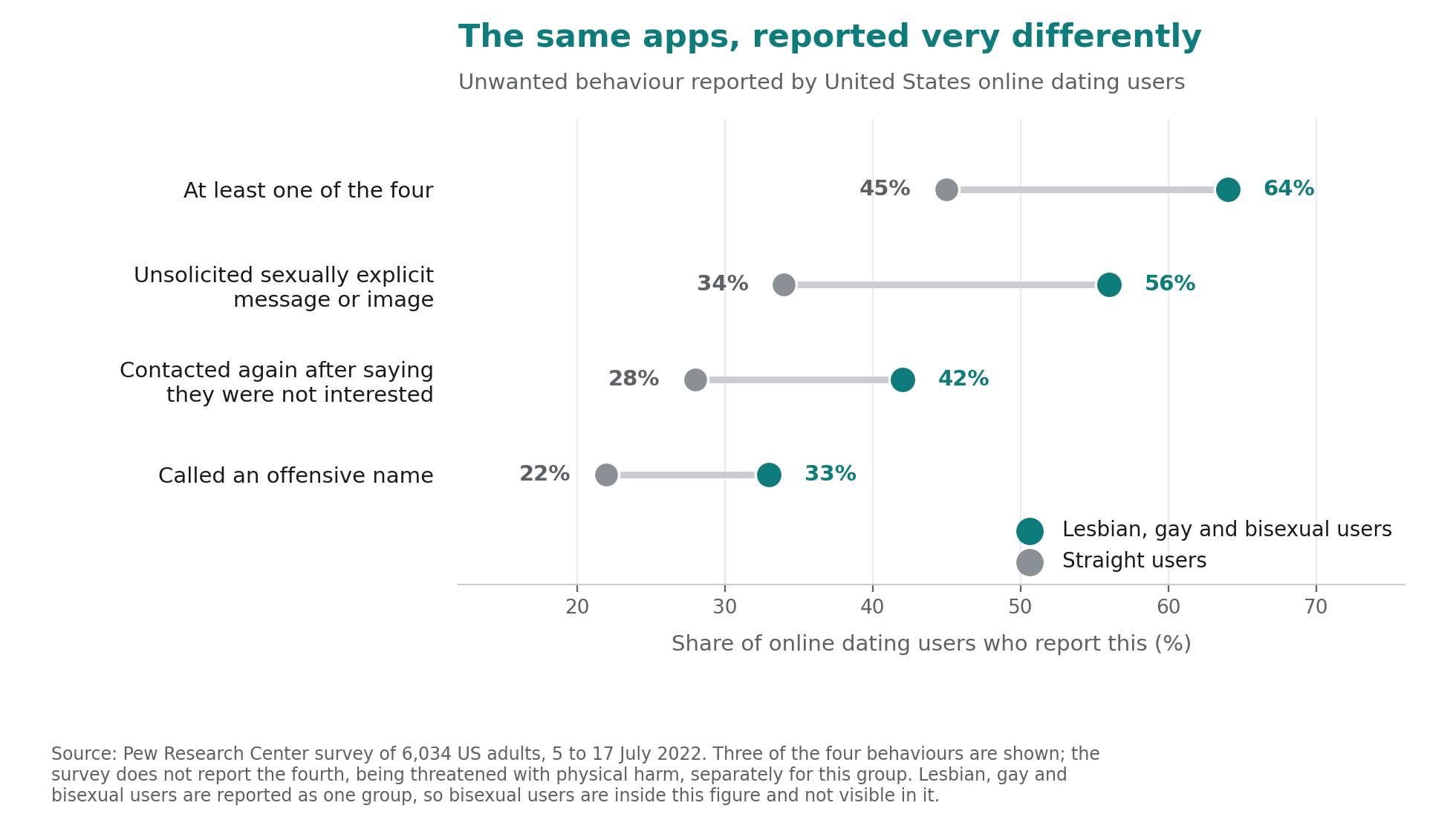
In Pew's survey, lesbian, gay and bisexual users reported more unwanted behaviour than straight users on every measure it breaks out, and the chart shows how big the gaps are. Here's what the chart can't show you. Pew counts lesbian, gay and bisexual users as one number, so bisexual people are in there without ever showing up on their own. The apps count people the same way they sort them.
Four questions to ask before you give an app three months
These work on any app, including this one.
Does it ask who you want to meet, as a separate question from what you are? Can you name more than one group? Does the other person also have to have picked your group? And can other members filter or search by your orientation?
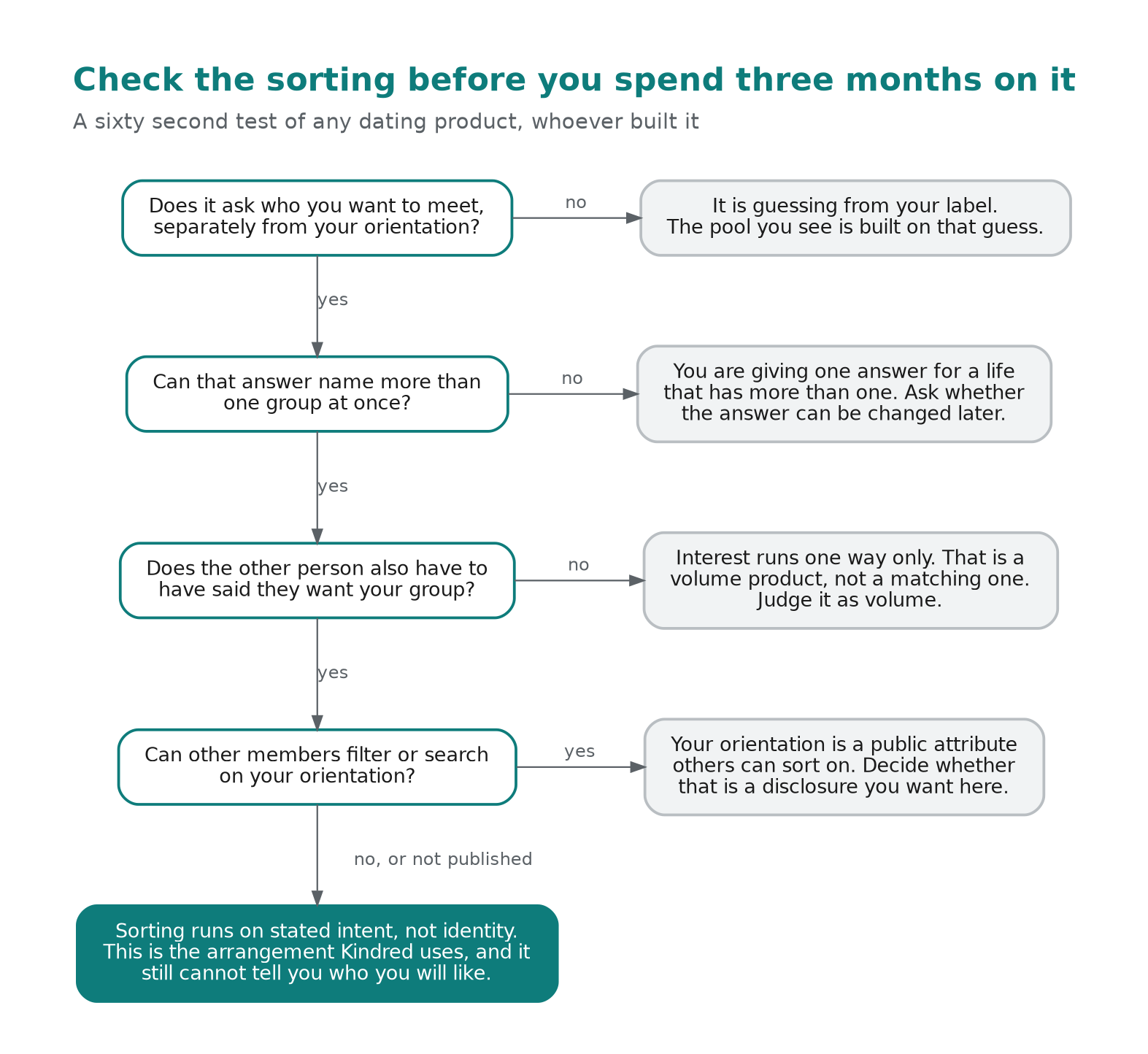
Keep this. An app that asks what you are and then guesses who you want has turned your identity into a filing instruction. An app that asks who you want, and makes the other person answer the same about you, has turned it into a preference. You'll see the difference in who shows up, not in the ads.
Key takeaways
Two things limit you, and neither is your profile. People: research shows straight, gay and lesbian people are all less willing to date bisexual people, and most of all bisexual men. Apps: they take what you are and guess who you want, then let others filter by the label. The four questions above test any app for that second problem.
Where Kindred fits in
Since you're reading this on Kindred's site, here's the short version, and then you can get on with your day. Kindred asks who you want to meet as its own question, and you can name more than one group. That answer works both ways, so you only match with someone if you each picked the other's group, and your orientation never decides who you're shown. It's one pool for everyone, not a separate bisexual version.
What it can't do matters just as much. It can't make anyone willing to meet you. And it can't tell you who you'll click with, because nobody can. The most direct test of that (opens in a new tab) fed more than a hundred things people said about themselves into a computer before they met, and still couldn't guess which two would want each other, even when every pair was one man and one woman, which is about as easy as predicting gets. More of that research is here. Kindred is a non-profit, open now in the Greater Toronto Area with a waitlist for other cities. Membership is a one-time fee instead of a subscription, which is why a subscription pulls the other way. That's the context. The four questions above are the part you keep.
Questions people actually ask
Is dating harder if you are bisexual?
The research points at other people, not the size of your pool. When researchers asked people how open they were to dating each other, straight, gay and lesbian people were all less willing to date a bisexual person than bisexual people were to date them. The reluctance was strongest toward bisexual men.
Do bisexual men have it harder than bisexual women?
In that same research, yes. The reluctance to date a bisexual person was strongest when that person was a man, and it showed up even among bisexual women. The researchers call it bias about bisexuality, not a simple preference for dating your own kind.
Does being bisexual actually give you more options?
On paper, yes. In practice, far less than you'd think. Two things shrink it. A lot of people won't date someone bisexual at all, and most apps take your orientation and quietly decide who to show you. The bigger pool never really reaches you.
Why do dating apps feel worse when you're bisexual?
Partly because they sort you by one word, and partly because more goes wrong on them. In a large US survey (opens in a new tab), lesbian, gay and bisexual users reported more unwanted behaviour than straight users on every measure, from unsolicited explicit images to being contacted again after saying no.
Can a dating app tell who I'll be attracted to?
No, and neither can anyone showing you a compatibility score. The most direct test (opens in a new tab) fed more than a hundred things people said about themselves into a computer before they met, and still couldn't predict which two would want each other. Every date in it was one man and one woman.
How is Kindred different?
Kindred asks who you want to meet as its own question, and you can name more than one group. That answer works both ways, so you only match if you each picked the other's group, and your orientation never decides your pool. It still can't tell you who you'll like, though. Nobody can.