Everyone has a list, and nobody will read theirs out loud. We are not talking about the socially acceptable one about kindness and ambition that you would happily recite on a first date. The real one, the one running through your head that has been disqualifying people for years. No guy who still lives with his mother. Nobody whose entire personality is a vegan podcast they will not shut up about. The woman who describes herself as not like other girls, a claim that has, in the entire history of the sentence, only ever been made by someone exactly like other girls. The man whose best photo is him holding a fish he caught, a decision he made on purpose and is apparently proud of. And somewhere on that list, unspoken yet accessed daily, sits a rule about cup size that only ever gets vocalised when you are 10 drinks in.
You have been running every person you meet against this list for years, and lately you have started to wonder if the list itself is the problem. It is the most natural worry in the world. Let us walk you through why it is mostly the wrong worry.
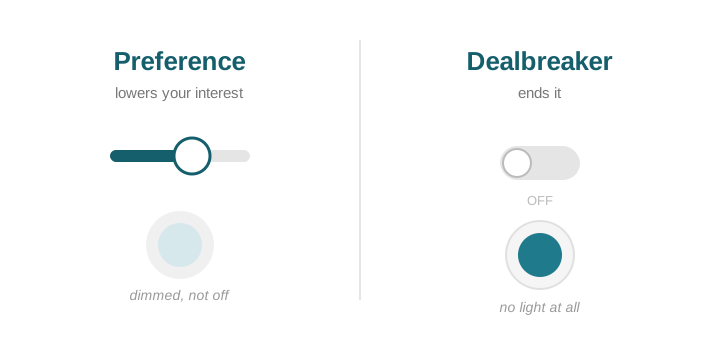
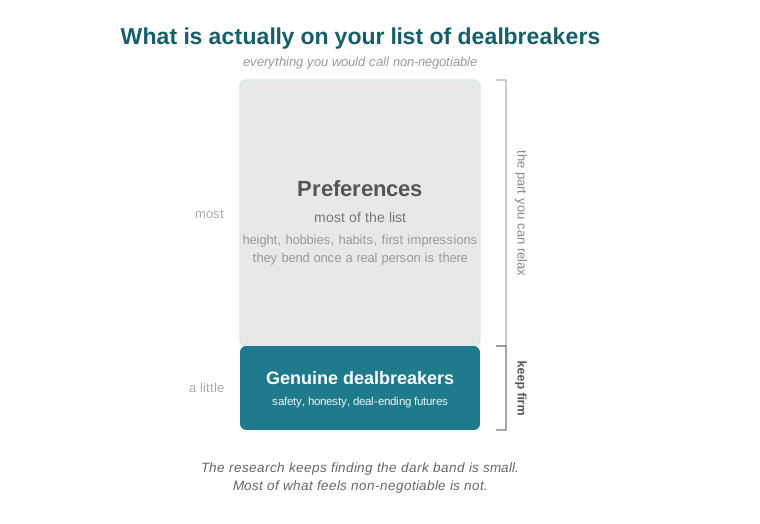
Almost everything on your mental list of dealbreakers is actually a preference. A preference lowers your interest in someone. A dealbreaker ends it. Those feel like the same thing when you are swiping, but they behave completely differently once a real person is in front of you, and the research on this is remarkably consistent. Most of what you call non-negotiable turns out to be very negotiable. A smaller, genuinely important set, the things that touch your safety or your future, really is non-negotiable, and always was.
That distinction is the whole article. If you get nothing else, get that. The rest is us showing you why it is true, how to tell the two apart in about four questions, and why the apps quietly make you worse at it. We are the team building Kindred, a not-for-profit matchmaking service, and we spend an unreasonable amount of time thinking about what people rule out and why, so this is the piece we wish someone had handed us.
1. Most of your dealbreakers bend, and the research proves it
The things you swear are non-negotiable mostly bend the moment a real person is attached to them. This is one of the sturdier findings in a field that does not have many.
Start with the big one. In 2015 a team led by Peter Jonason ran six studies with more than six thousand people (opens in a new tab) on the traits people most want to avoid in a partner. The findings are about what you would expect from a species that has been hurt before: cruelty, dishonesty, someone already taken, serious substance problems, someone whose standard of hygiene is a matter of ongoing debate. People also weigh one bad trait more heavily than one good one. So far, this matches how you already think of yourself, and if the story ended here you would just be picky.
It does not end here. In 2022, researchers Samantha Joel and Nicolyn Charlot ran the experiment we wish we had thought of. They took people who had just named their absolute, non-negotiable dealbreakers, then introduced a hypothetical person who had one, and watched. The people did not leave. They renegotiated. Someone would say, with total conviction, that they could never date a smoker, be told this person smokes, and then sit there and think about it. On average it took several dealbreakers stacked on one person (opens in a new tab) before anyone walked. One, on its own, was a rounding error. The researchers, who clearly grew fond of these people, gave the effect a gentler name than it deserved. They called it a dealbender.
Read that twice, because it takes you off a hook. A real judgement is cumulative. You weigh everything at once, and a dealbreaker almost never shows up alone, with nothing good on either side of it.
And if you still will not believe your own flexibility, a 2024 study led by Kathryn Walter worked backwards from how real couples actually paired up (opens in a new tab), testing whether the classic dealbreakers behave like walls that disqualify a person outright, or like weights that just lower the score. Smoking, height, religion: weights, every one. There is a couple out there right now, perfectly content, one of whom has a firm height requirement the other has never met, and neither of them can recall it ever coming up. That is most of your list. Not a wall. A weight you have been calling a wall.
2. A small part of your list really is non-negotiable
Now the other half of the distinction, and this is where we stop being playful. Some things genuinely should end it, and no research about averages changes that. They come in two kinds.
The first is safety, consent, and basic trust. Violence. Coercion. Someone lying about who they are or whether they are even single. These do not go into the weighing machine, and the same research that shrugs at smoking is completely clear that hostility and serious problems are a different category. A boundary that keeps you safe does not need a study behind it. If your list is heavy on this kind of thing, you were never too picky, and we mean that.
The second is futures that cannot both happen. Whether you want children. Whether you would move. What you are actually here for. These are not good-or-bad questions, they are same-direction questions, and the reason to raise them early is not romance, it is arithmetic: they cost you a coffee to find out in week one and a year to find out in month eight. Asking early does not make you intense. It makes you someone who refuses to lose a year to hope.
Everything else, which is genuinely nearly all of it, is preference. So when you ask "am I too picky," the honest answer is usually no, you are just filing "abusive" and "shorter than me" under the same heading, and those were never the same heading. If the swiping itself is grinding you down, we wrote separately about why your dating app is quietly built to keep you single.
3. The apps are making you feel pickier than you are
Dating apps train you toward rejection: the more profiles you see in a row, the more likely you are to say no, almost regardless of who is in front of you. You have felt this in your own thumb.
Tila Pronk and Jaap Denissen ran three experiments on what a swiping session does to you (opens in a new tab). Across a single session, the odds of saying yes to anyone fell by 27 percent, and the slide started almost immediately. Not more discerning. More rejecting. By the bottom of the session you are turning down people you would happily have said yes to at the top, for no reason except that the app has shown you enough faces that no single one clears the bar. It builds the pickiness, then sells you the cure, and the cure is more faces, which is where the pickiness comes from.
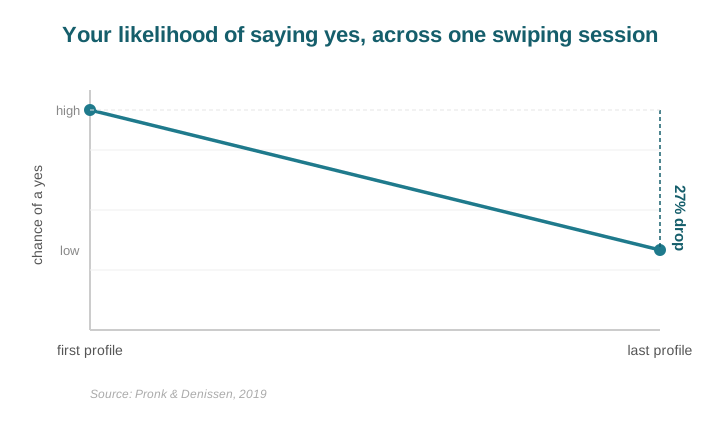
Sit with that, because it moves the blame onto the machine. The endless feed is not just eating your evenings, it is teaching you to say no, one profile at a time, until you are a stingier version of the person who opened the app, and then it hands that stingier version more people to reject. It is the only business we can think of that sells you the thirst and the salt in the same subscription. So if you feel pickier than you used to be, you might be right, and it might not be your fault, and the fix is not "lower your standards." The fix is to stop doing your screening in the one place designed to warp it.
4. How to actually sort your list, in four questions
You do not need us for this part, which is exactly why we want to give it to you. Four questions sort almost anything you are tempted to rule out. Ask them in order.
One. Is it about danger or dishonesty? Then it is a wall, not a preference, and it never enters the weighing machine, no matter how funny he is over text. Especially then.
Two. Would being with this person mean one of you giving up something central, a child you do or do not want, a city you will not leave? Then it is a same-direction question, worth saying out loud early rather than waiting for it to resolve itself, which it has never once done for anyone.
Three. Does it lower how much you like them, or does it genuinely make the relationship unworkable? The first is a preference to test on a real person. The second might be a wall, but only if you can say, in plain words, what the person would actually have to do, rather than which box they failed to tick.
Four. Would your answer change if you knew a little more? Then it was a preference all along. Preferences are the things worth holding loosely, because the evidence says they loosen on their own the moment a real person is in front of you.
So: rule out what threatens your safety or your consent, flatly, no weighing. Get clear and early about the handful of futures that genuinely cannot share a roof. And hold the rest as preferences to test in person, rather than verdicts passed on people you have not met. Do that, and the question stops being "am I too picky" and becomes "am I sorting these right," which is a question you can actually answer.
Frequently asked questions
What is the difference between being picky and having standards?
Standards are about character, values, and life goals that affect a real relationship. Pickiness is ruling people out over small preferences like height or a hobby before you know them. The research finds most stated dealbreakers are preferences, not genuine standards, and they bend once a real person is attached to them.
How do I know if I am too picky in dating?
A useful test is whether you rule people out over single traits before meeting them, and whether your list of requirements has grown longer over time rather than shorter. Research shows people usually pass several of their own stated dealbreakers before actually walking away, so a firm-sounding list is rarely the real obstacle.
How many dealbreakers is too many?
There is no fixed number, but a 2022 study found people absorbed several negative traits about a hypothetical partner before ending it, and one dealbreaker alone was rarely enough. What matters is not the count but whether each item is a genuine safety or compatibility issue, or just a preference you could test in person.
Is it bad to have dealbreakers when dating?
No. Some dealbreakers are essential: safety, consent, honesty, and futures that cannot coexist, like whether you want children. The problem is only when preferences that lower your interest without ending a relationship, like height or a hobby, are treated as hard walls. Keep the first kind firm and hold the second kind loosely.
Do dating apps make you pickier?
Yes. A study of swiping sessions found the odds of saying yes to anyone fell by about 27 percent from the first profile to the last, and the decline started almost immediately. Seeing many faces in a row trains a more rejecting frame of mind, largely regardless of who is actually shown.
What should count as a real dealbreaker?
Three things: anything touching your safety or consent, such as violence or coercion; dishonesty about who someone is or whether they are available; and futures that genuinely cannot both happen, like children or where you will live. Almost everything else is a preference worth testing against a real person rather than enforcing against a profile.
Where we come in
If, having sorted your list, you would rather not go back to enforcing it by hand across an endless feed, that is the exact problem we built Kindred for. It applies your eligibility rules and your genuine dealbreakers before it ranks or proposes anyone, so nobody is ever put in front of you just to be rejected. The obvious mismatches are gone before you see anything, and the screening happens once, up front, instead of hundreds of times in the setting the research says turns you into a machine for saying no.
Two honest limits, because they matter more than the feature. First, clearing away who you do not want is not the same as knowing who you will want, so we show no compatibility percentage and make no claim to predict who you will fall for. What we can do is remove the people you told us were wrong; which of the rest you like is a question a first conversation answers. Second, a short, clean set of introductions guarantees nothing. What it changes is where your attention goes: onto a few people who clear the things you were firm about, instead of onto rejecting strangers in bulk. That is the whole claim, and it is about your attention, not your future.
If sorting your list yourself and then never having to enforce it on a feed again sounds better than another two years of quality control at one in the morning, the next step is below. Less exciting by design. Kindred is open now in the Greater Toronto Area, where the first 1,000 members join free for life. Everywhere else, the waitlist is open, and each registration counts toward opening that city.