Type "dating after 40" into a search bar and the autofill finishes the thought for you: is it too late. That suggestion was built by everyone who typed the question before you, read the results, and felt worse. So here is the answer the first page of results keeps missing. People in their 40s and early 50s are the least likely adults to be living without a partner. The famous "women peak at 18" statistic comes from a study of people who averaged 31. And the thing that genuinely changes after 40 is not your prospects but the problem itself: less "find someone", more "fit a particular person into a life that already works". Kindred, the Canadian not-for-profit matchmaking service publishing this, is built for that second problem.
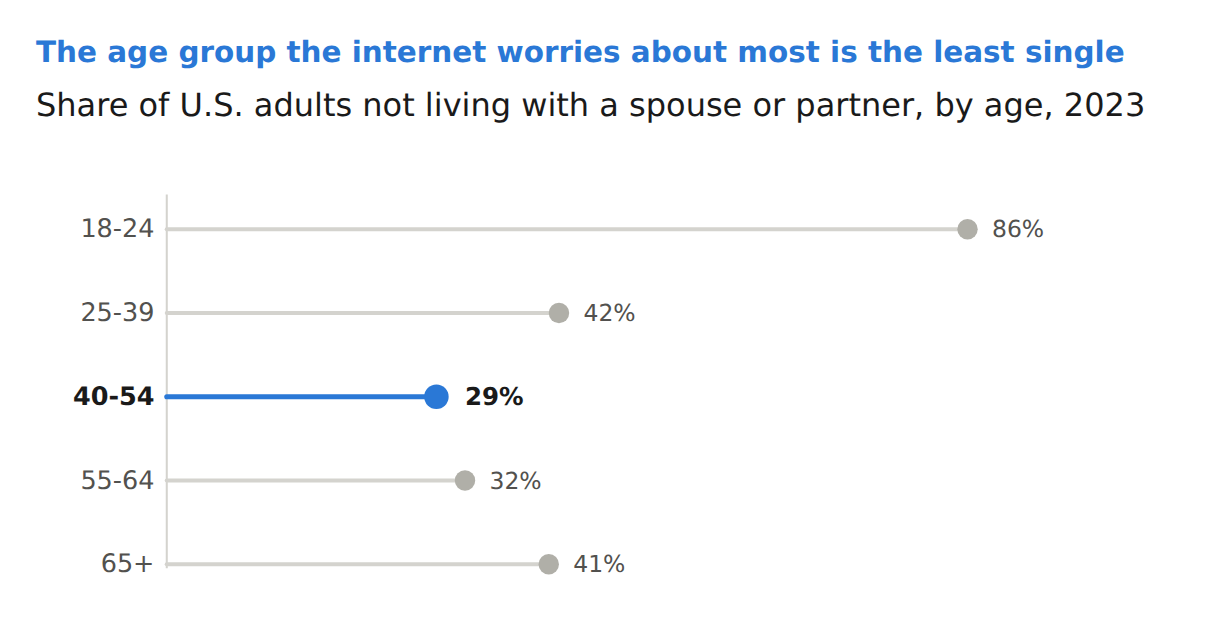
What changes after 40 is the problem, not your prospects. People in their 40s and early 50s are the least likely adults to be without a partner, and the men-to-women arithmetic holds up fine until much later in life. The scarce resource is not people. It is evenings.
Is the pool really smaller after 40?
Smaller than it was at 25, yes. Emptier, no. The most recent national figures (opens in a new tab) put people in their 40s and early 50s at the bottom of the singleness table, below every other adult age group, including the twentysomethings everyone assumes are having a better time of it. (The under-25s sit at the top, mostly because they have been adults for about twenty minutes.) The chart shows how far apart the age groups actually sit. The one the internet frets over hardest is, on the evidence, the one it should fret over least.
If your particular dread involves the ratio of men to women, that one is also better than advertised. Through the 40s and 50s, men and women are single at similar rates. The lopsided numbers you have read about are real, but they belong to the retirement years, where widowhood and life expectancy do the counting. That is a genuine demographic fact, and it was never going to be fixed by the advice column telling you to hold the camera higher.
One more number, because it gets waved around as proof of social collapse: a quarter of American 40-year-olds have never married (opens in a new tab), where a generation ago it was almost nobody. The wavers usually omit that a good chunk of those never-married people were living with a partner at the time. "Never married" is a fact about paperwork. It is not a biography, and it is certainly not a waiting room.
One honest caveat: "unpartnered" is not a headcount of people free for dinner on Friday. It includes people who are not looking, and it misses some committed couples who keep separate homes. Take the number for what it proves, which is that the pool did not drain while you were busy having a life, not as a promise about who is available this week.
Did you really peak at 18?
No. The number that launched a thousand headlines describes messaging behaviour on one free dating site, over one month in 2014, among users who averaged about 31. The study itself (opens in a new tab) is careful and interesting. Its afterlife is neither. Researchers watched who messaged whom in four American cities and built a "desirability" score using a formula borrowed from how Google ranks web pages, applied here to human beings with the same warm intimacy. On that score, women's number declined from 18 onward and men's rose until about 50. That, in its entirety, is the factual basis for a decade of articles informing you that you have expired.
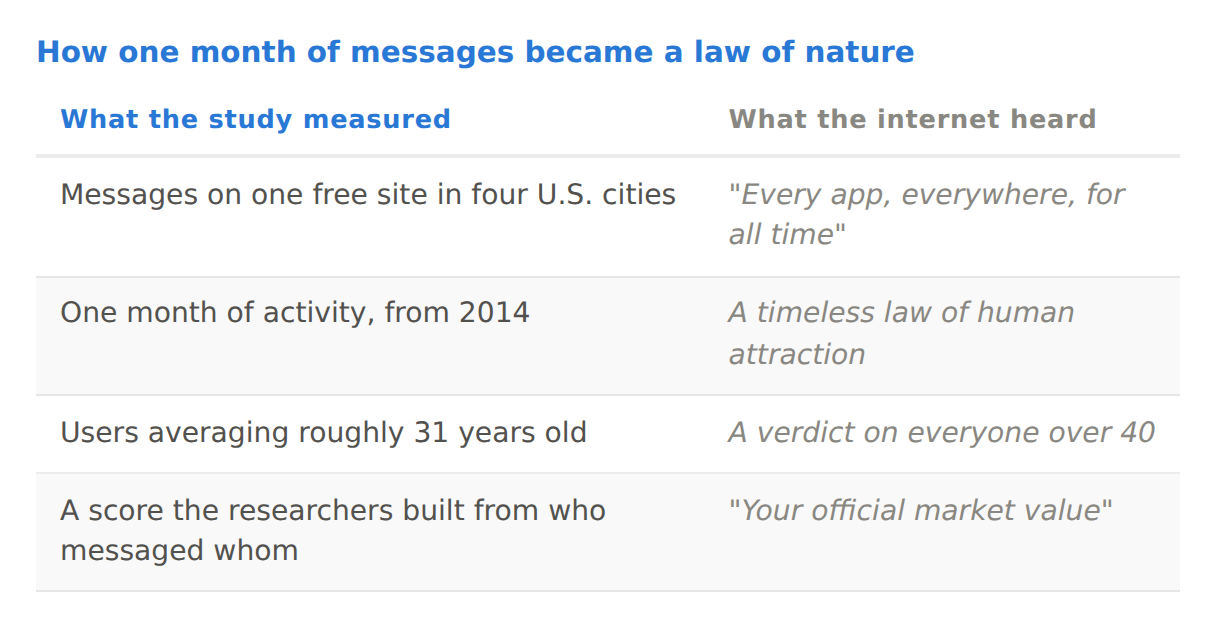
A record of who messaged whom on one site twelve years ago is a fine thing to know. It is not a law of physics, it does not follow you from app to app like a credit rating, and it has never once been present at a dinner where two people in their forties discovered they both hate the word "foodie". A messaging pattern among people averaging 31 is evidence about people averaging 31. Applying it to yourself at 47 is astrology with a bibliography.
And when researchers finally watched people meet instead of type, the story fell apart. A recent study of thousands of blind dates (opens in a new tab) arranged by a matchmaking service found that after an actual date, both men and women tilted slightly toward younger partners, by the same amount. The tidy arc where women depreciate and men appreciate did not survive contact with a restaurant. The internet has not updated its articles, but then the internet is not the one buying you dinner.
Worth keeping. What people say they want is a weak forecast of who they enjoy across a table, age preferences included. That is also why no questionnaire score deserves your faith. Your checklist is a hypothesis. The date is the data.
What actually changes after 40?
The constraint moves. At 25, two people can build a life from scratch, which carries the underrated advantage that neither of them owns furniture worth defending. At 45, a relationship has to dock with a life already in motion: a mortgage, a school pickup at 3:15 pm, a parent who calls during dinner, and three genuinely free evenings a month, one of which you are reserving for the disciplined practice of doing absolutely nothing. That is not decline. It is logistics, and logistics is a solvable class of problem, which decline is not.
Some people are not late to this. They were occupied. In interviews with older online daters (opens in a new tab), many had put off looking for a partner until their caregiving years were finished. The industry files these people under "set in their ways", which is a remarkable label for someone who kept another human being alive for a decade and would now like a pleasant dinner. The useful question was never whether they are open enough. It is whether any product they are handed knows how to ask about the shape of their weeks.
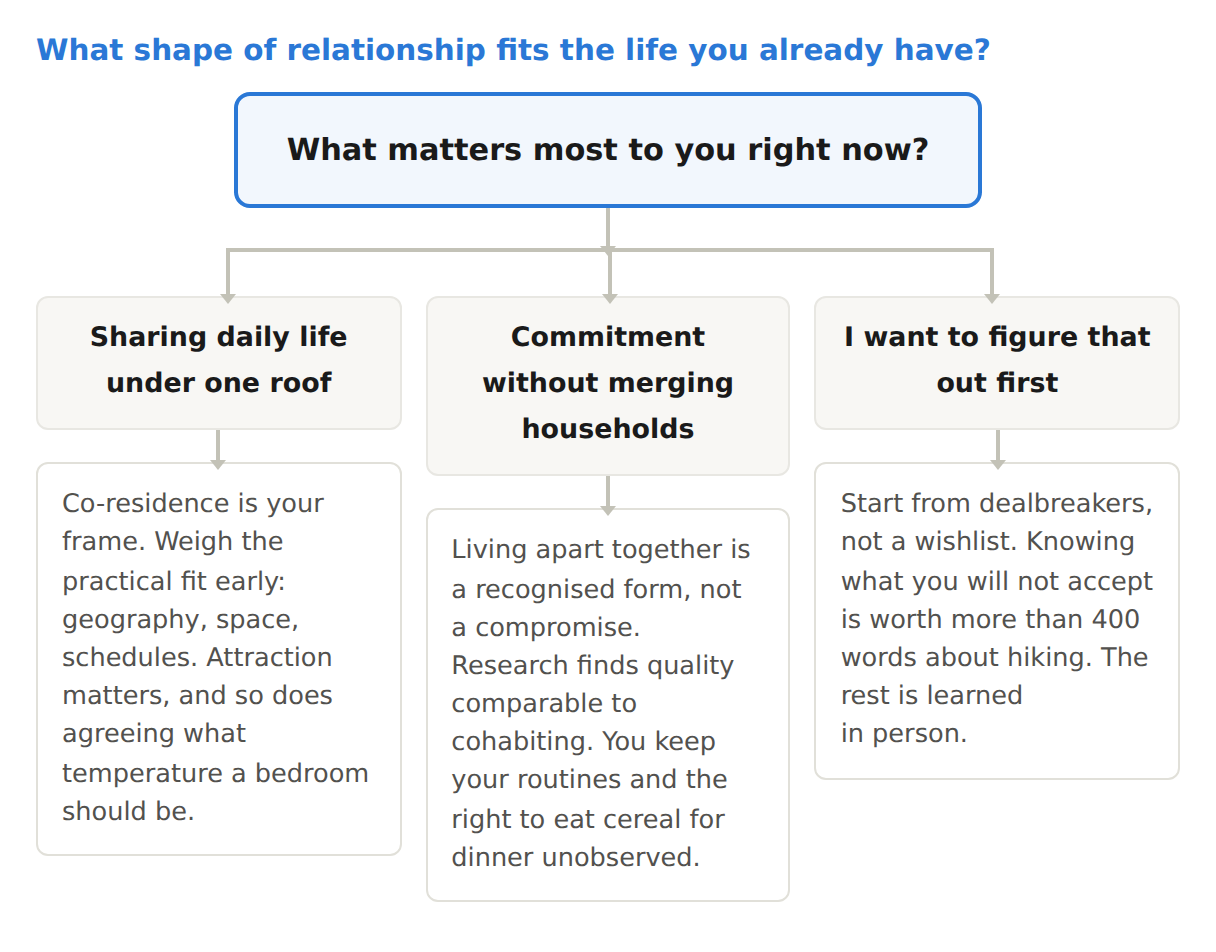
The other change is that "relationship" stops meaning one thing. Among partnered people in their 50s and early 60s, a national study (opens in a new tab) found that dating, living apart together (a committed couple keeping two homes) and living together looked remarkably alike on most measures of relationship quality, with marriage scoring higher on happiness and commitment but holding no monopoly on either. A long-running UK study (opens in a new tab) found people's mental health was better in a living-apart relationship than when single, with little difference between that, living together and marriage. Keeping your own front door is not a failure to commit. Sometimes it is the load-bearing wall of the commitment.
How Kindred is built for the problem you actually have
Kindred starts from the constraint this whole page has been describing: your evenings are finite, so introductions are too. There is no feed and no swiping. A short questionnaire asks about the things people report reliably and that make or break a relationship structurally: children (wanted, not wanted, already here), faith and whether a partner must share it, the relationship structure you are after, whether marriage is the goal, whether you drink, and six more. Anyone whose answers make a pairing impossible never appears in your pool, and you never appear in theirs. No evening spent, no hope raised. An unlimited feed offered to a person with three free evenings a month was always a strange gift, like a firehose for someone who asked for a glass of water.
What Kindred will not do is put a number on chemistry. A compatibility percentage is a questionnaire wearing a lab coat: it is generated from what you typed at 11:30 pm, by a system that has met neither of you, and displayed with the confidence of a blood test. We cannot tell you who you will click with, and neither can anyone selling you a percentage. What Kindred is designed to do instead is rank the remaining pool on behaviour and reciprocity as the pool grows, meaning whether interest plausibly runs in both directions, and then follow up on what happened after real introductions so the matching learns from outcomes rather than from its own opinion of itself. Version one of this is a good filter, honest ranking and no theatre. If that sounds modest, it is. Modest is what honest looks like in this market.
The economics point the same way. Kindred is a Canadian federal not-for-profit and membership is one payment, ever: no subscription, no boosts, nothing to buy once you are in. Nobody's revenue improves when your search takes longer, which is not something the monthly-billing model can say, for reasons that are arithmetic rather than villainy. A subscription is patient in a way that is not a compliment. Kindred is built to lose members, on purpose, for the best available reason. Being over 40 is not a problem, so Kindred is not a solution to it. It is a better-shaped tool for the question you are actually asking, which is not "am I desirable" but "who fits the Tuesdays I actually have". If your Tuesdays are shaped by children, there is a whole page about that.
Key takeaways
People in their 40s and early 50s are the least likely of any adult age group to be living without a partner, and gender balance holds through the 40s and 50s. The "women peak at 18" claim comes from one month of messaging on one dating site in 2014, among users averaging 31; a newer study of real blind dates found no gender difference in age preference. What genuinely changes after 40 is logistics: established lives, finite evenings, and a wider set of workable relationship shapes, including committed couples with two front doors. Kindred, a Canadian not-for-profit, is built for that problem: a dealbreaker filter instead of a feed, finite introductions, no compatibility percentages, one fee paid once. It is open now in the Greater Toronto Area, with a waitlist for other cities. Current pricing is in Kindred's FAQ and the founding-member terms are on the join page, rather than in this article, because a price is the kind of thing that changes and this page is built to stay true.
Questions people actually ask
Is dating after 40 harder than in your 20s? Different, not uniformly harder. People in their 40s and early 50s are the least likely of any adult age group to be living without a partner, and men and women are single at similar rates through the 40s and 50s. What changes is the logistics of fitting a person into an established life.
Is it true that women's dating value peaks at 18? No. The claim comes from one 2018 analysis of messaging on a single dating site in 2014, where the average user was about 31. When a newer study followed real blind dates, men and women showed the same slight tilt toward younger partners, with no difference between the genders.
Does online dating work if you are over 40? It is one route among several, not the main one. In a 2022 Pew survey (opens in a new tab), 3 percent of adults 50 and older were current or recent users of a dating site or app, and about half of recent users cited finding a long-term partner as a major reason. Unwanted contact and romance scams are documented risks at every age.
What is a living apart together relationship? A committed couple who keep separate homes. In research on adults over 50, these relationships look similar to cohabiting ones on most measures of quality, and a long-running UK study found that moving into one was associated with improved mental health. It can protect routines, housing and care obligations while the relationship stays serious.
How is Kindred different from dating apps? Kindred is a not-for-profit that charges one fee, once, and sends a finite number of introductions instead of a feed. A dealbreaker filter removes structurally impossible pairs first; as the pool grows, ranking is built to draw on behaviour and reciprocity, and the system is designed to learn from what happens after real introductions. It publishes no compatibility percentages.
What does it cost to join Kindred? Membership is always a one-time fee, never a subscription, and what you pay depends only on when you join. Everyone keeps the rate they joined at. Joining the waitlist for a city outside the GTA is free. Current pricing is in Kindred's FAQ, and the founding-member terms are on the join page.