The date was fine, and that is the whole problem: no spark, no story, and no clear idea whether to go again. No spark on a first date does not mean attraction cannot grow, and it does not mean you owe anyone a second evening. First impressions (opens in a new tab) really do predict later interest, and plenty of couples (opens in a new tab) felt nothing at first and warmed up later. What nobody can hand you is the odds that your particular quiet evening becomes attraction, or a magic number of dates that settles it.
The useful question is not spark versus failure. It is no, maybe, or yes. And maybe is allowed to stay maybe for one more evening, which is precisely the answer the apps are built not to allow: two buttons, three possible human reactions. No spark is not the same as no interest. No interest is also enough.
What does “no spark” actually mean?
No spark just means there was no strong immediate pull. It is not a verdict, and it is not the same as no interest. Part of the trouble is that “spark” is doing five jobs at once: physical attraction, an easy back-and-forth, curiosity, a jolt of nerves, or plain relief that the person across the table asked you a question back. Because it stands for so many things, it is close to useless as a way to score an evening, which is roughly why the people who study attraction (opens in a new tab) gave up on one clean definition and track several separate things instead.
A clear no is simple: you felt nothing, you did not enjoy the hour, or you would rather not see them again, and you owe no one a reason, though most of us build one on the ride home anyway. A maybe is the interesting one: comfortable enough, and interesting enough that another hour sounds fine rather than like a chore. A yes means attraction is here now, which is real and worth taking seriously, and still only tells you about now.
Do first impressions on a date mean anything?
Yes. Your first impression carries real information about what you will do next, and almost none about where you will be in a year. That first read you took of them was not nothing. When strangers meet and size each other up (opens in a new tab), those first-minute impressions line up with who they later chase and who they let go.
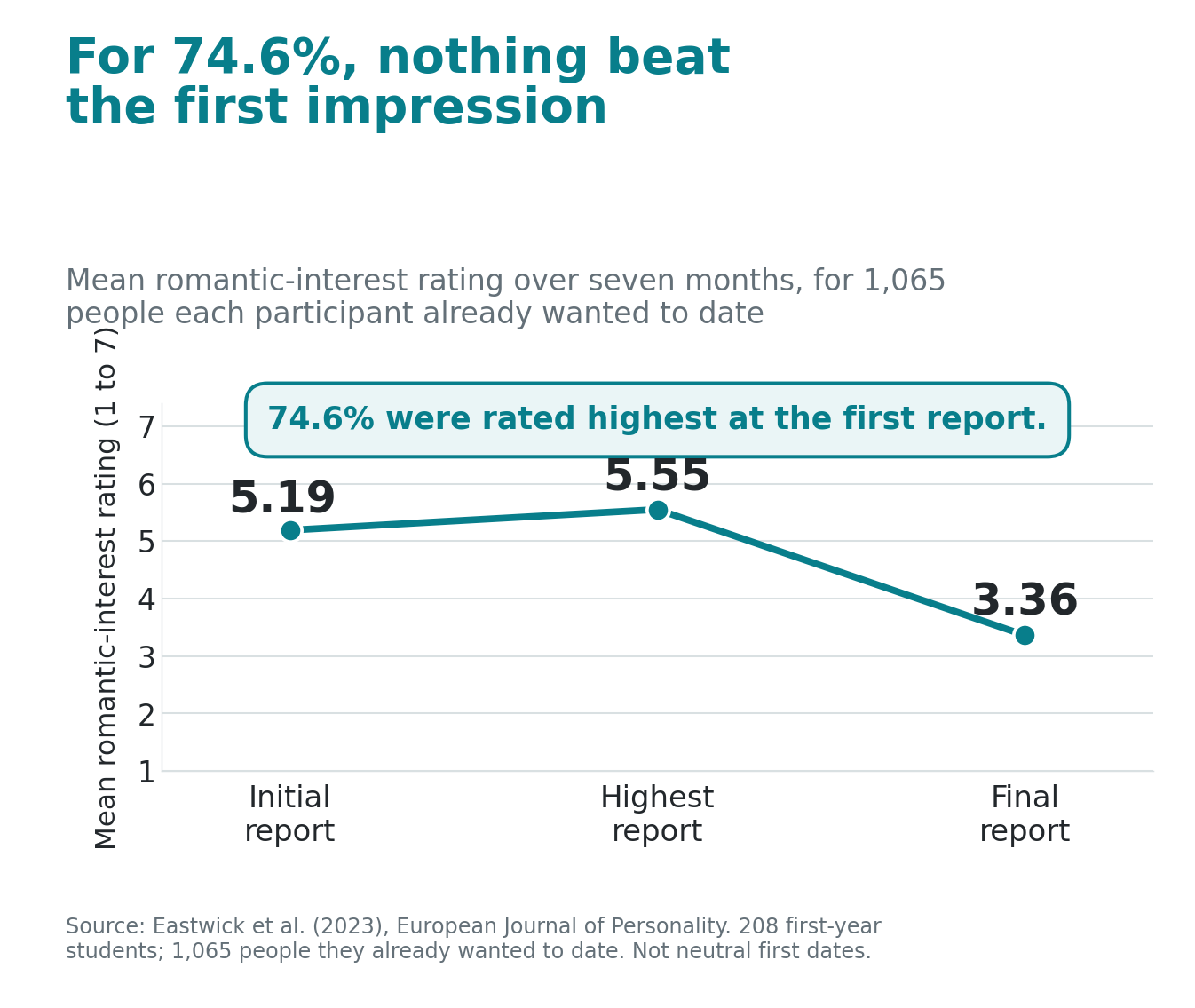
It runs deeper than a single evening. In one study (opens in a new tab) that followed people month after month, interest tended to peak right at the start and cool from there, and for most of them the first meeting was as warm as it ever got. The catch, and it is a big one: these were people who already saw each other as possibilities, not fine, spark-free first dates. Read it as a caution against treating a first impression as destiny, not as proof that a quiet start is doomed. The chart shows the shape of it.
So your first impression deserves neither a shrine nor a shrug. The industry sells you both mistakes at once, often on the same screen: the app swearing the first flush is fate, right beside the article swearing it is nothing.
Can attraction grow after no spark?
Yes, attraction can grow after a flat first date, and no, nobody can tell you the odds that it will for you. Plenty of good relationships never had a first-date spark. They started as friendship, or as two people who kept landing in the same room, and the attraction turned up later. Ask people in long relationships (opens in a new tab) how theirs began and about two thirds say it started as a friendship, with many adding that neither of them was interested at first.
Here is what that does, and does not, mean for you. It means a flat first impression is honestly not a verdict; attraction has a slower door, and people walk through it all the time. It does not mean the odds are good for any one quiet date, because these are stories told looking backward, by the couples who worked out. The near-misses that fizzled are not around to be asked.
One thing is easy to mix up. Seeing someone again and again does tend to make you like them more, but when that is tested (opens in a new tab), what grows is liking, not wanting, and the two are not the same. And if you want someone to just tell you the odds, the honest answer is that nobody can: the research barely exists (opens in a new tab), and only three studies have ever followed people forward from a first meeting to see who actually paired off. Three, for a question this many people are asking. So anyone handing you a percentage is guessing.
Why does a fine date feel like a letdown?
Often it is the feed, not your standards: scrolling through many profiles trains you to reject, so a perfectly good date can read as worse than it was. Scrolling through profile after profile (opens in a new tab) makes people harder to please as they go, and acceptance drops by more than a quarter between the first option and the last. The scrolling is not the whole story, but the drift is real: the feed did not lift your standards, it trained your thumb to say no. If you have ever wondered whether you are actually too picky, this is a large part of the answer.
After a fine date, the comparison in your head is rarely this person versus nobody. It is this person versus the next twenty profiles, every one of whom hikes, travels, is “fluent in sarcasm,” and has never once been photographed within 50 metres of a grocery store. A nice evening can look like a weak audition against an imaginary rival with better lighting and no visible flaws.
This is worth catching yourself doing. “Would I enjoy another hour with this actual person?” is a very different question from “Did this person beat the entire theoretical internet?” Only one of those has an answer.
Should you go on a second date with no spark?
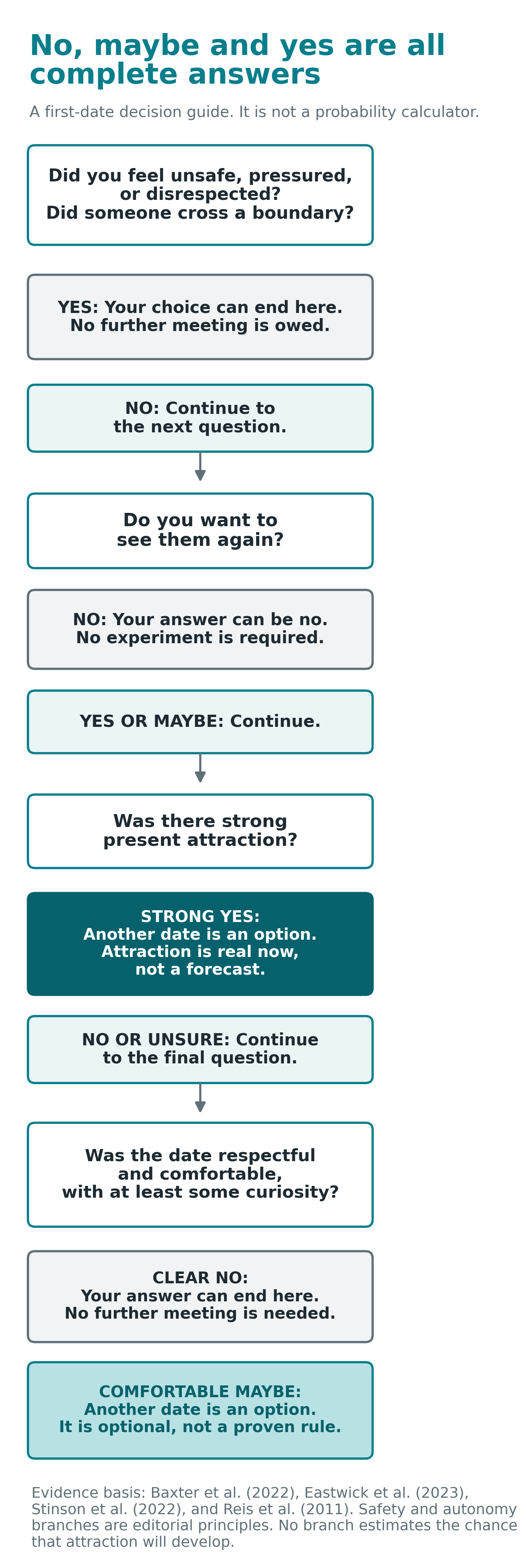
A second date is worth it only if you are genuinely curious and felt safe and comfortable; it is an option, never an obligation. Safety comes first: if you felt unsafe, pressured, or disrespected, or if someone crossed a boundary, you do not need another meeting, and not wanting to see them again is reason enough on its own.
If the evening was respectful and comfortable and some real curiosity is still there, a second date is a reasonable experiment. The reasons are the ones above: first impressions sharpen as you get to know someone (opens in a new tab), familiarity can grow into liking (opens in a new tab), and plenty of couples started with no spark at all (opens in a new tab). None of that makes a second date a rule; it makes it an option, not a test you can pass or fail.
A strong spark, when it is there, is real information about the present, but the research does not settle its long-term value (opens in a new tab). It is not proof of compatibility, and it is not a warning sign, whatever the “red flag” content mill tells you.
Key takeaways
No spark on a first date is information, not a verdict, and it is not the same as no interest. A clear no needs no reason; a maybe is a complete answer that earns one more evening if you are curious. First impressions genuinely predict what people do next but not how a year turns out, and attraction does sometimes grow after a flat start, most visibly in relationships that began as friendships, though no study can give you the odds for your particular date. A long feed quietly trains you toward no, so weigh this person against another hour with them, not against the next twenty profiles. Go again if you are curious and felt comfortable, stop if you did not, and distrust anyone, app or article, who claims to know who you will fall for before you have met them.
What can a dating service do about chemistry?
It cannot manufacture chemistry or predict who you will click with. The honest most it can do is clear structural dealbreakers, keep your options few enough that your attention has somewhere to land, and stay out of the way. The plain version, the one this whole piece has been walking toward: nobody can tell you who you will click with before you meet them, and anyone selling you a compatibility percentage is charging you for the guess.
Kindred’s matching starts with a short dealbreaker filter, then ranks what is left, offering curated, finite introductions instead of an endless feed, with no compatibility percentage on the screen and no paid boost to the top of the queue. None of it manufactures chemistry; we would love to tell you it was hiding in your answer to question fourteen, but it was not, and we checked. Kindred is a Canadian federal not-for-profit built around a one-time membership rather than a monthly subscription, which changes the incentive, not the underlying reality: a not-for-profit still cannot see who will make an hour vanish for you. It can only decline to charge you for pretending it can.
Kindred is open now in the Greater Toronto Area. Everywhere else, the waitlist is open, and a city enters the queue at roughly 500 registrations. For the pilot, the first 1,000 members join free and stay free; later pilot members pay a one-time $25 CAD, and the standard fee after the pilot is a one-time $50 CAD. Joining does not promise a match or a chemistry prediction, and joining a city's waitlist does not promise a launch date.
Common questions about first-date chemistry
Can attraction grow after no spark on a first date?
Yes, it can. Research on friendships that became romances, and experiments on repeated contact, both show attraction or liking can develop with familiarity. Neither tells you how often a neutral first date specifically gets there, so treat the possibility as real and the odds as genuinely unknown.
Should I go on a second date if there was no chemistry?
A second date is optional. The evidence is too thin to call it right for everyone, but it is reasonable when the first evening was respectful and comfortable and you are still curious. A maybe is enough reason for one more hour, and not a commitment to anything past it.
How many dates should I give someone?
There is no research-backed number. No study endorses a two-date rule, a three-date rule, or any universal quota; the three-date rule is folklore, not a finding. Give someone as many evenings as your curiosity honestly wants, and not one more out of obligation or a rule you read online.
Is instant chemistry a sign of compatibility?
It is a sign of present attraction, not proof of a future. Initial interest does predict early pursuit, but whether a first-date spark predicts long-term satisfaction, commitment or stability has not been established. Let it tell you how you feel tonight, not how you will feel in a year.
What is the difference between no spark and no interest?
No spark means there was no strong immediate pull. No interest means you do not want to continue. They often travel together, but they are not the same thing, and either one is a complete answer on its own, whatever an app with a single reject button implies.
Can friendship turn into romantic attraction?
Yes, and often. Across retrospective studies, about two thirds of people said their relationship began as a friendship, and many said the attraction arrived only after the friendship did. The pathway is real; it just cannot promise that your particular friendship, or your particular fine date, will follow it.